10 Venice’s Best Bridges
In this post, you’ll discover the city’s most famous bridges, the very ones that connect the islands of the romantic city of Venice.

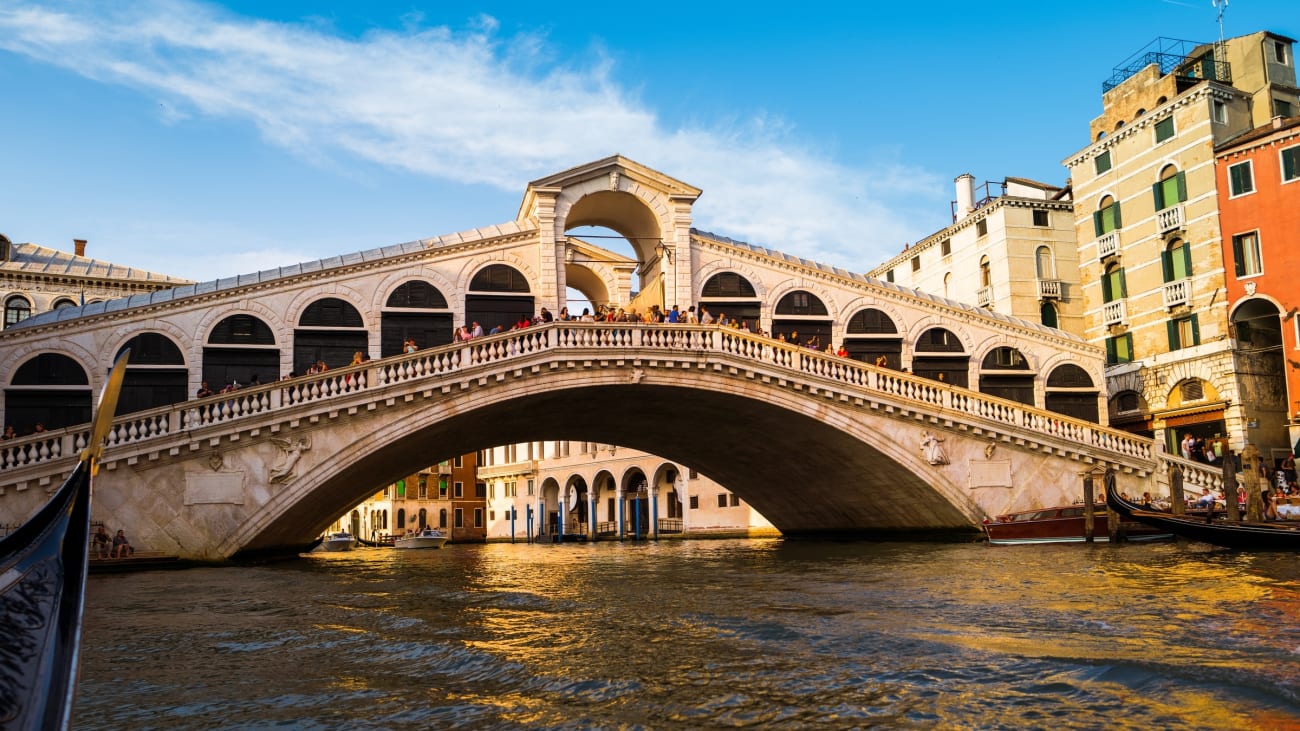
Rialto Bridge, Venice | ©Vincenzo Landino
Did you know that… more than 350 bridges connect the 118 islands that make up Venice? That is why Venice is famous for its network of bridges and narrow streets, which give the city a very distinctive atmosphere. Some of the bridges you’ll discover in this post are steeped in history and beauty, and offer views well worth capturing on camera.
1. Rialto Bridge

The Rialto Bridge is one of the four oldest bridges in Venice (built in the 16th century). It is one of the most interesting sights to see in Venice; moreover, it is the focal point of both the city and the Grand Canal.
This bridge was built between 1588 and 1591, taking just three years to complete. The Rialto Bridge replaced four bridges that stood there previously and was the only way to cross the Grand Canal on foot until 1854, when the Accademia Bridge was built.
You will see that it is a stone arch bridge spanning the narrowest part of the Grand Canal. It has long been regarded as an architectural and engineering feat of the Renaissance. If you look closely, you will see that there are up to 6,000 wooden piles beneath each pier, all designed to support the weight of the stone arch, which gives it that Baroque touch.
How to get to the Rialto Bridge
The Rialto Bridge is located in the San Polo district of Venice, connecting to San Marco. The ‘Rialto’ vaporetto stop is right next to it, and the bridge is easily accessible on foot from almost anywhere in Venice. Wherever you go, signs will point you in the direction of the Rialto. To give you a reference, it’s about a ten-minute walk from St Mark’s Square.
Of course, if you’re at Venice airport or somewhere else far from the city centre, you can take the bus routes (4L, 5, 6, 6L, 7E, 8E). You can also get there by train on lines (R, RV), or even by vaporetto along the Grand Canal on lines (1 and 2).
- Address: Sestiere San Polo, 30125 Venice, Italy.
- Tip: Here’s a post on getting around Venice that will undoubtedly be very useful for understanding the different modes of transport available.
2. Bridge of the Fists

Ponte dei Pugni, or the Bridge of Fists, is another of Venice’s best-known bridges. This is because it was the site where, for years, two rival gangs—the Nicolotti and the Castellani—clashed, fighting with their fists.
Tradition also has it that the victors would throw the losers into the water, an act made easier by the fact that, until recently, the bridge had no railing. Fortunately, these fights were banned in 1705 due to their excessive violence.
In the case of the Ponte dei Pugni, its appeal is directly linked to its history, as you can still see markings on the bridge’s floor, signs that indicated where the two rivals should stand.
Near the Ponte dei Pugni there is a large stall selling fresh fruit and vegetables, a characteristic feature of the area. I would also recommend taking a photo of the Indiana Jones Library, a very famous building.
How to get to the Ponte dei Pugni
The Ponte dei Pugni is a small bridge located in the Dorsoduro district, halfway between Campo San Barnaba and Campo Santa Margherita. Personally, I recommend walking there, as the whole walk is well worth taking your time over. That said, if you want to cut the journey short, I suggest taking Venice’s vaporetto line 1.
- Address: 30123 Venice, Italy.
3. Bridge of Sighs
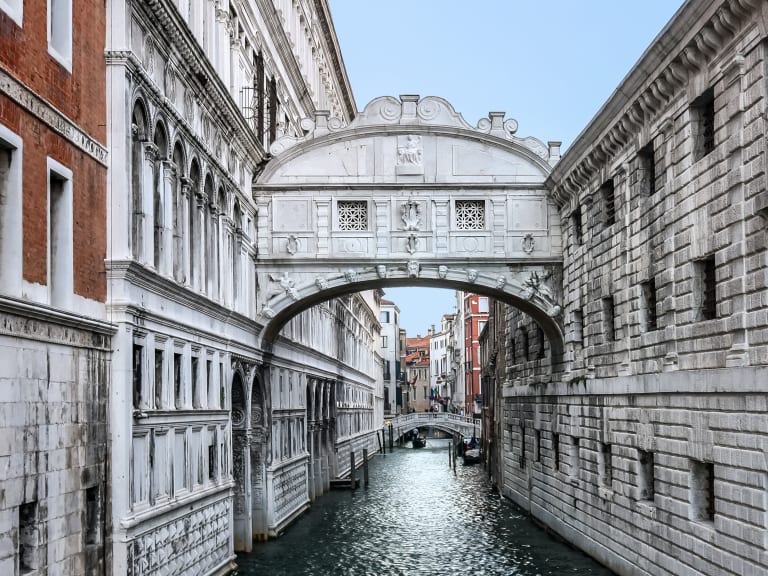
The Bridge of Sighs is one of Venice’s most important bridges. It was built in the early 17th century, and its name derives from the sighs heard from those crossing the bridge who were about to be imprisoned. This theory was popularised by Lord Byron, who mentioned it in some of his most famous writings, which also helped to make the bridge famous.
It is a bridge just 11 metres long which formerly provided access to the palace’s old prisons. It has a very Baroque style, is white in colour and is steeped in history. Now you know where to go if you want to relive the memories of the thousands of innocent prisoners during the long and harsh Inquisition.
How to get to the Bridge of Sighs
The Bridge of Sighs is located near St Mark’s Square. To get there by train from Piazzale Roma, you can choose between the R or RV line and get off at the ‘Vallaresso’ stop. If you prefer to take the vaporetto, you can disembark near the square using line 1.
- Address: Piazza San Marco, 1, 30124 Venice, Italy.
4. Bridge of the Barefoot

The Ponte degli Scalzi (Bridge of the Barefoot) is one of the four bridges in Venice that cross the Grand Canal. It was designed by Eugenio Miozzi and completed in 1934 to replace an Austrian iron bridge (all the iron bridges in Venice had been built by the Austrians). The idea was to build something of their own design and clearly demonstrate Italy’s rise to prominence.
If you look closely at the bridge, it borrows the main features of the Rialto Bridge, with the exception of the decorative lines and the fact that it is built of white stone. It is undoubtedly one of the bridges you should visit at night in Venice, as from here you can admire the illuminated cruise ships on the Grand Canal.
How to get to the Bridge of the Barefoot
The bridge connects the sestieri of Santa Croce and Cannaregio. To the north of the bridge are the Chiesa degli Scalzi (Church of the Barefoot Monks) and Santa Lucia railway station. To the south, you reach the Piazzale Roma coach station. You can reach the bridge by taking bus routes 2, 4L, 5, 6, 6L, 7E or 8E.
- Address: Ponte degli Scalzi, 30135 Venice, Italy.
5. Academy Bridge

Ponte dell’Accademia connects the San Marco district with Dorsoduro, home to the Accademia Gallery. The bridge is renowned for offering the best views of Venice, as you can gaze out over the Grand Canal in both directions from a relatively high vantage point.
Best of all, you’ll notice a stark contrast compared to the other marble bridges in Venice, as this one was built of wood. Personally, even if you were only in Venice for a single day, I’d recommend visiting this bridge as it gives you a better overall sense of how the city is laid out.
What’s more, near the bridge are some of the best places to eat on a budget in Venice.
How to get to the Academy Bridge
The bridge is located at the final bend of the S-shaped Grand Canal, just before the canal enters St Mark’s Basin. I also recommend crossing the bridge if you’re on your way from St Mark’s Square to the Galleria dell’Accademia, the Peggy Guggenheim Collection or the Church of Santa Maria della Salute.
The best way to reach the bridge is by vaporetto , using lines 1 and 2. Bus routes 10A, 53E, 6, 6E, 6L, 7, 7E and 8E are also useful if you’re looking to shorten your journey.
- Address: 30100 Venice, Italy.
6. Paja Bridge

The Ponte della Paglia (Straw Bridge) connects the Castello district with San Marco. It was originally built in 1360 and rebuilt during the 19th century.
Its name comes from the boats that used to moor at the bridge whilst unloading straw to be transported to different areas. This activity was banned due to the risks involved. This famous bridge became an emblem for Italian painters, a detail that radically increased its popularity
Ponte della Paglia is the perfect spot to take a photo of the Bridge of Sighs, as it is very close by – two birds with one stone!
How to get to the Ponte della Paglia
I would recommend following the route from the Bridge of Sighs to the Ponte della Paglia, given their proximity and the interesting route between them. That said, if you’re looking to get straight to the bridge, I’d advise taking the bus routes (10A, 24, 4L, 6, 6E, 6L) or the vaporetto routes (1 or 2).
- Address: Piazzetta San Marco, 30124 Venice, Italy.
7. Calatrava Bridge

Completed in 2008, the Calatrava Bridge was designed by the Spanish architect Santiago Calatrava. It is the last of the four bridges crossing the Grand Canal; however, it must be said that it was a controversial addition due to its modern appearance, which contrasted with the city’s Renaissance style.
Venice’s modern bridge, officially named Ponte della Costituzione, serves a clear and important purpose: to link Santa Lucia railway station with Piazzale Roma, thereby connecting the only part of the city accessible by car.
It is an excellent spot from which to watch the gondolas glide by, or even to pluck up the courage to take a ride in one.
How to get to the Calatrava Bridge
The bridge is located 1.3 kilometres from the Rialto Bridge. Therefore, to reach Calatrava’s Bridge, you can choose a Grand Canal cruise or take vaporetto line 2.
By bus, the best option would be to take lines 6E or 7E.
- Address: Ponte della Costituzione, 30135 Venice, Italy.
8. Bridge of the Spires

The Ponte delle Guglie is one of the two bridges crossing the Cannaregio Canal, situated at its western end, near where it joins the Grand Canal.
The bridge is close to Venezia Santa Lucia railway station, not far from the Rialto Bridge. You’ll notice that the stone and brick bridge features highly ornate decoration, including gargoyles on its arch.
It is also known as the "Bridge of the Spires" due to its metal spires (the only bridge in Venice with this feature).
How to get to the Bridge of the Spires
This bridge is just 1 kilometre from the Rialto Bridge, so you can easily walk there if you’re in the city centre. You can also get off near the bridge if you take Venice’s vaporetto line 1.
- Address: 30121 Venice, Italy.
9. Bridge of Liberty
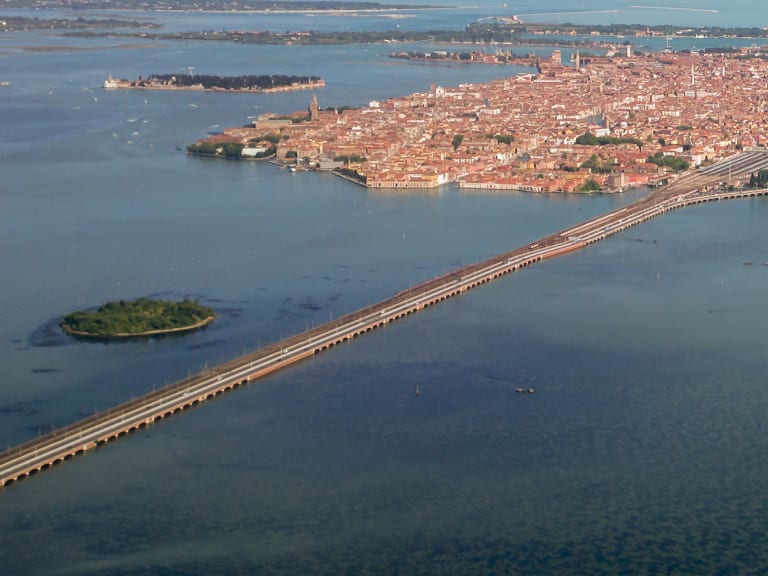
This bridge connects Italy with the islands that make up the city of Venice. The Ponte della Libertà used to be known as the Ponte Littorio. The bridge was inaugurated by the Italian dictator Benito Mussolini in 1933 and renamed after the Second World War to commemorate Italy’s liberation from fascism.
If you arrive at Venice Santa Lucia station, you can see the bridge from the window. It is a bridge measuring 3,850 metres! Nothing like the length of the bridges connecting the islands of Venice.
This bridge, rather than a place to visit, is a way of reaching Venice from the town of Menestre; in other words, it is the footbridge that will welcome you to this romantic city.
10. Breast Bridge
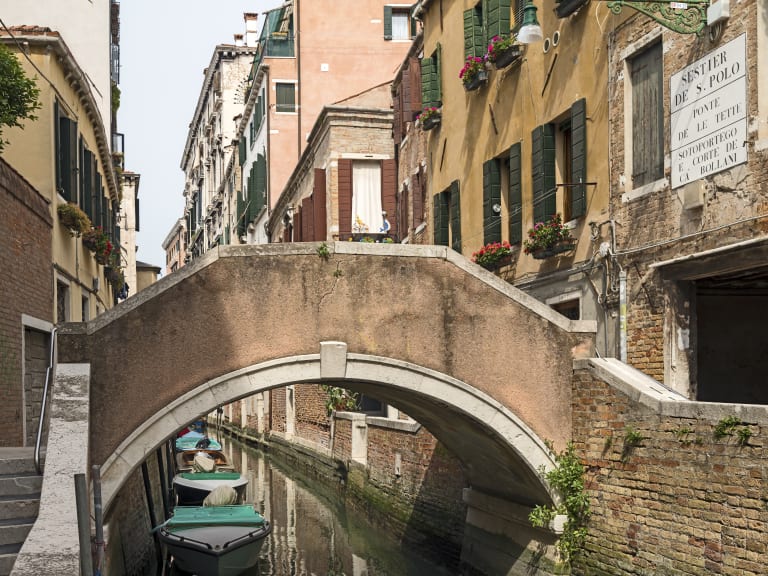
This bridge in San Polo has a long history, as it used to connect to Venice’s nightlife district. It is a reddish bridge, short in length and strikingly distinctive.
To better understand the origin of the name, we must go back to the 15th century, when the Venetian government issued a decree allowing prostitutes to advertise their services by leaning out of their windows and exposing their breasts (all for the purpose of collecting taxes). It was this practice that ultimately gave the bridge its current name.
How to get to the Bridge of the Breasts
Personally, I recommend visiting the Bridge of the Breasts after seeing the famous Rialto Bridge, as it is just 500 metres away. On the way, you’ll pass through Campo di San Silvestro and Rio de San Aponal.
- Address: Via San Cassiano, 30125 Venice, Italy.